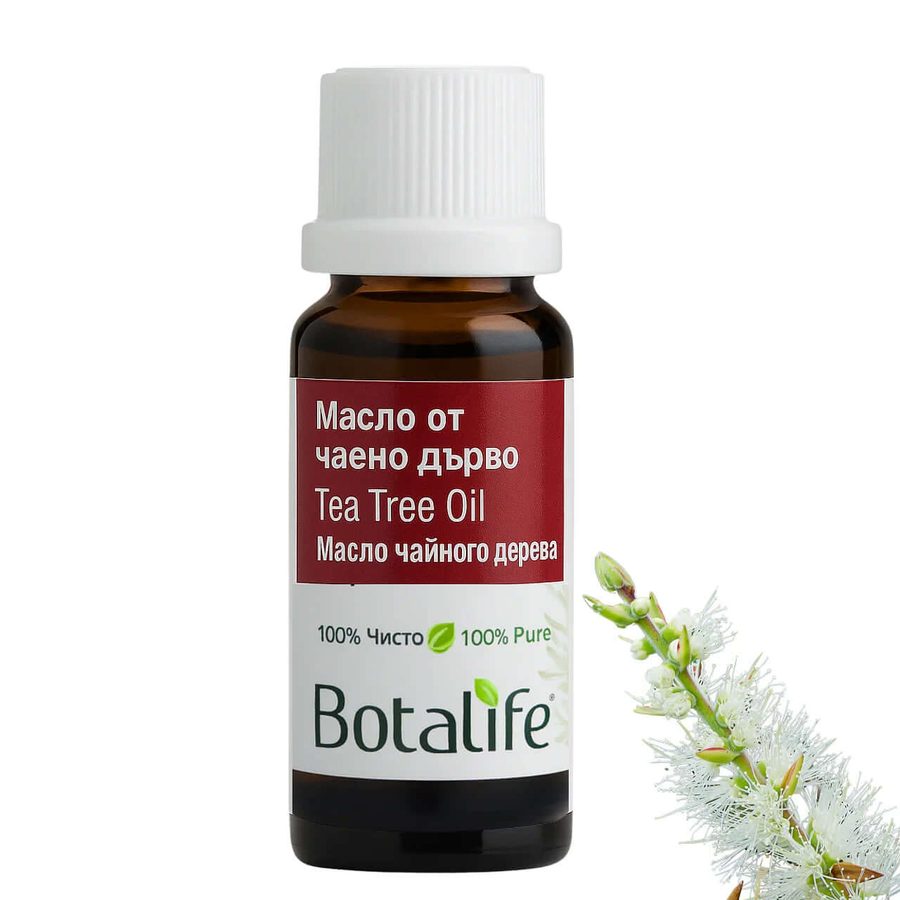
Tea tree essential oil, 10 / 20 ml
10.95 €
- 10 ml – 10.95 €
- 20 ml – 15.90 €
10.95 €
100% pure tea tree essential oil
/Melaleuca alternifolia leaf oil/
Produced by steam distillation.
Externally: for inhalation, aromatherapy, massage, as an addition to cosmetics.
See: Recipes.
The oil must not be taken internally, as it is toxic.
Caution!Not recommended in cases of individual intolerance or during pregnancy. Protect the mucous membranes when using it; it should also not be used on deep wounds or near the nose and ears. Tea tree oil is not irritating or toxic when used externally, but some people may experience irritation of sensitive skin, so we recommend doing a test before use by applying one drop of the oil to the inside of your wrist.
*The effects, methods of use and dosages cited in Botalife's articles and in the leaflets enclosed with each product apply only to Botalife-branded products, for which Botalife guarantees the concentration, purity, quality and origin of the oils.
1. An antiseptic for cuts and grazes: Tea tree oil can be used successfully to disinfect and heal cuts and grazes, killing S. aureus and other bacteria that can cause infection in open wounds.
2. Fighting acne: Tea tree oil can be a powerful weapon against acne. Several studies show that it helps reduce the amount and overall severity of acne. Applying a 5% tea tree gel to acne lesions has also been shown to be more than three times as effective at reducing the number of lesions as a placebo.
Another study found that tea tree oil is just as effective against acne as benzoyl peroxide, the most common anti-acne medication.
3. Nail fungus: Fungal nail infections are quite common. Tea tree oil has been shown to help get rid of nail fungus when used on its own or in combination with other natural remedies.
In a controlled study, people with nail fungus used pure tea tree oil as an antifungal for six months. At the end of the study, 60% of the people had partial or complete removal of the fungus.
4. Fighting dandruff: Tea tree oil is very beneficial for the health of the hair and scalp. Like coconut oil for hair, tea tree oil can soothe scalp inflammation, prevent the scalp from flaking, remove dandruff and is used to treat lice.
5. Effective against athlete's foot: Athlete's foot is a contagious fungal infection of the feet that can also spread to the fingernails and toenails. Symptoms include peeling, cracking, blisters and redness. Antifungal medicines are considered the standard treatment for athlete's foot. Yet studies show that tea tree oil can be an effective alternative for relieving the symptoms.
In a controlled study of 158 people, 72% of the tea tree oil group had a significant clinical improvement in athlete's foot, compared with 39% in the placebo group.
6. An effective remedy against mould on fruit and vegetables: Fresh produce is undeniably tasty and healthy. Unfortunately, it is susceptible to the growth of grey mould, known as Botrytis cinerea, especially in warm, humid climates. Studies show that the antifungal compounds in tea tree oil, terpinen-4-ol and 1,8-cineole, can help reduce the growth of this mould on fruit and vegetables.
7. Relieves psoriasis: Psoriasis is an autoimmune condition characterised by patches of red, itchy, flaky skin. Although there are medicines that can improve the symptoms, the condition itself is chronic and has no known cure. Tea tree oil contains anti-inflammatory compounds which, according to emerging evidence, may be useful for relieving psoriasis symptoms.
8. Soothes inflamed skin: Tea tree oil can help soothe inflamed skin. A common form of skin irritation is contact dermatitis, which occurs when the skin comes into contact with an allergen. Exposure to the allergen leads to red, itchy and sometimes painful skin. Animal and human studies show that applying tea tree oil can help reduce the severity of these symptoms.
In a study comparing the effects of different treatments for contact dermatitis, tea tree oil was found to reduce symptoms by 40%, which is significantly more than standard medicines applied to the skin.
In addition, tea tree oil can provide relief from reactions to insect bites by reducing the itching, redness and swelling that occur when your body releases histamine to protect itself against the insect's saliva.
9. A natural deodorant: The antibacterial effect of tea tree oil can help control underarm odour related to sweating. Sweat itself does not smell. However, when the secretions from the sweat glands combine with bacteria on the skin, a moderate to strong odour is produced. Your underarm area contains a high concentration of these glands and is mainly responsible for what is commonly called “body odour”. The bacteria-fighting properties of tea tree oil make it an ideal natural alternative to commercial deodorants and antiperspirants.
10. A natural insect repellent: Tea tree oil acts as a natural insect repellent. One study found that 24 hours after treatment with tea tree oil, cows had 61% fewer flies than cows not treated with tea tree oil.
In addition, a test-tube study revealed that tea tree oil is better at repelling mosquitoes than DEET, the most common active ingredient in insect repellents.
11. A natural hand sanitiser: Tea tree oil is an ideal natural hand sanitiser. Studies show that it kills several common bacteria and viruses responsible for causing illness, including E. coli, S. pneumoniae and H. influenzae.
What's more, a study testing several types of hand soap showed that adding tea tree oil to them increased their effectiveness against E. coli.
12. An effective remedy against bacteria in the mouth: Research shows that tea tree oil can fight the germs that cause tooth decay and bad breath.
According to one study, tea tree oil is more effective against plaque-causing bacteria than chlorhexidine, a common disinfectant mouth rinse.
13. An all-purpose cleaner: Tea tree oil is a great all-purpose cleaner that also disinfects surfaces. And it does so without leaving traces of chemicals that you would not want your family members or pets to come into contact with.
Certificate No.: TR-32-К-003617
Packaging: glass bottle with dropper, 10 ml
Storage: in a dark, cool place, out of the reach of children, with the cap tightly closed
Best before: see packaging
Manufacturer: Manolya Dogal ve Aromatik, Turkey
Exclusive importer for Bulgaria: Botalife Bulgaria Ltd.
1. Homemade anti-acne wash mask: mix 5 drops of tea tree oil with 2 tbsp of honey. Apply to clean, washed facial skin, leave for one minute and then rinse.
2. Anti-acne toner: mix 10 drops of tea tree oil with 50 drops of pure distilled water and apply this toner to the affected areas with a cotton pad.
3. Against dandruff, lice, inflammation and flaking of the scalp: mix 5 drops of tea tree oil with 25 drops of carrier oil. Massage this mixture into the scalp, leave for 30 minutes and wash off.
Add a few drops of tea tree oil to your shampoo.
4. To remove warts: tea tree oil is dripped directly onto the area for 30 days, once or twice a day.
5. Against athlete's foot: mix 1 tbsp of baking soda with 20 drops of tea tree oil. Stir to combine and store in a closed container. Apply to clean, dry feet twice a day.
6. Against mould on fruit and vegetables: add 5–10 drops of tea tree oil to a bowl of water, soak the fruit and vegetables for 5 minutes, then dry them.
7. To disinfect laundry: add a few drops of tea tree oil to your washing powder.
8. To disinfect and heal wounds: mix 1 drop of tea tree oil with 5 drops of St John's wort oil and apply to the wound.
9. For respiratory diseases, acute respiratory illnesses, viral diseases, laryngitis and tonsillitis: for this purpose, do a steam inhalation with tea tree oil – add 5 drops to boiling water. After removing it from the heat, cover your head with a towel and inhale the steam for 5–10 minutes.
10. To relieve psoriasis: mix 10–15 drops of tea tree oil with two tablespoons of melted coconut oil. Apply the mixture to the affected area 2–3 times a day if needed.
Inhalation with essential oils
TOP 7 essential oils for a blocked nose and sinuses
The 8 best oils for asthma symptoms
Essential oils for travel – how to create your own kit
TOP 5 essential oils for irritable bowel syndrome
TOP 6 essential oils for eczema
TOP 8 essential oils for earache
TOP 9 essential oils for chickenpox and how to use them
TOP 11 essential oils for herpes
TOP 12 essential oils for diarrhoea and how to use them
Essential oil conversion table, calculator and professional tips
TOP 9 essential oils for a sore throat
The best essential and plant oils for psoriasis
The best essential oils for warts
The most effective oils for seasonal and skin allergies
The best essential oils for sunburn
Essential oils that repel insects
4 ways to use essential oils safely internally, with recipes
The effects and uses of essential oils on the human body
How to use essential oils at home
How to make a natural sunscreen?
The 7 best essential oils for coughs
Main uses of various Botalife essential oils – Part 3
TOP 4 antibacterial essential oils
DIY: an all-purpose homemade balm with St John's wort and tea tree oil
How to make a homemade repellent against mosquitoes, ticks and insects?
Emotional balance and the nervous system
The vibrations of essential oils – Part 1
The most suitable essential oils for athletes
TOP 10 benefits of tea tree oil
The 10 best essential oils for healing and how to use them
Recipes for the immune system with Botalife essential oils
TOP 9 essential oils for food poisoning and how to use them
How to strengthen the immune system with Botalife essential oils?
TOP 10 essential oils for inflamed tonsils (tonsillitis)
Top 13 essential and plant oils for clearing parasites from the body
Tea tree oil comes from the leaves of Melaleuca alternifolia, a small tree native to Queensland and New South Wales, Australia. Although Melaleuca alternifolia is known as the tea tree, it should not be confused with the plants used to make black, green and oolong tea.
Tea tree oil has been used as traditional medicine by Aboriginal people for centuries. These native Australians crushed tea tree leaves to extract the oil, which was then inhaled to treat coughs and colds or applied directly to the skin for healing.
Today tea tree oil is widely available and has many uses. Tea tree oil contains a number of compounds, including terpinen-4-ol, which have been shown to kill certain bacteria, viruses and fungi. Terpinen-4-ol also increases the activity of white blood cells, which help fight germs and fungi. These germ-fighting properties make tea tree oil a valuable natural remedy for bacterial and fungal skin conditions, preventing infections and speeding up the healing process.
Tea tree oil has bactericidal, antifungal, antiviral and immune-stimulating properties. Like coconut oil for hair, tea tree oil can soothe scalp inflammation, prevent the scalp from flaking, remove dandruff and is used to treat lice.
Tea tree oil is used in medicinal preparations for all types of respiratory diseases, such as colds, acute respiratory illnesses, viral diseases, laryngitis and tonsillitis. It is also effective for colds because of its soothing and expectorant effect: it clears secretions from the airways and eases the patient's condition.