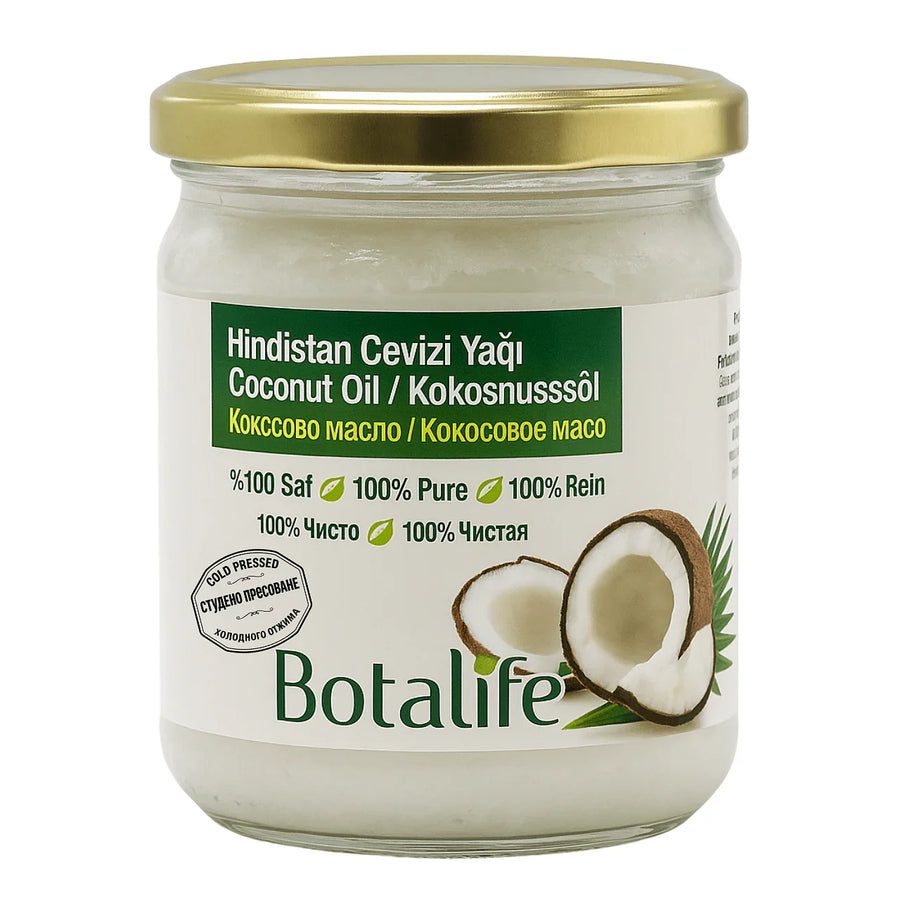
Coconut oil, 150 g / 300 g
12.95 €
- 150 g – 12.95 €
- 300 g – 20.90 €
12.95 €
100% pure coconut oil
/Cocos nucifera/
Cold-pressed. Unrefined.
Internally:
– for adults: 1 tbsp a day
– for children: 1 tsp a day
Externally: for massage, face and hair masks
Caution! This product is not a medicine! It should not be used as a substitute for a varied and balanced diet! Do not exceed the recommended daily dose!
If taken together with medicinal products, consult a pharmacist!
*The effects, methods of use and dosages cited in Botalife's articles and in the leaflets enclosed with each product apply only to Botalife-branded products, for which Botalife guarantees the concentration, purity, quality and origin of the oils.
1. Helps burn fat: Coconut oil is a rich source of medium-chain triglycerides, a type of saturated fat. In general, saturated fats are divided into three subgroups, each with a different effect on our body. These subgroups are long-chain, medium-chain and short-chain triglycerides. Scientists are studying medium-chain triglycerides, including those found in coconut oil, for their potential health benefits. For example, some studies show that eating coconut oil can increase the number of calories your body burns. In this way it may help promote weight loss.
2. A quick source of energy: The medium-chain triglycerides in coconut oil provide a quick supply of energy. They go straight to your liver and are converted into a fast energy supply in much the same way as carbohydrates – your body's preferred source of energy.
3. Normalises blood sugar levels: Coconut oil promotes the use of blood glucose, helps control blood sugar and improves insulin secretion.
4. For maintaining a healthy body: The strong antioxidant and immune-boosting properties of coconut oil keep the thyroid gland, immune system and nervous system in good condition. The medium-chain triglycerides in coconut oil help prevent liver, kidney and gallbladder diseases, kidney stones, and bladder and pancreatic diseases.
5. Has a strong antimicrobial action: Coconut oil has strong antimicrobial and antifungal properties due to its lauric acid content. Lauric acid is a fatty acid that makes up about 50% of the medium-chain triglycerides in coconut oil. Research shows that it may have strong antimicrobial effects against disease-causing microorganisms such as Staphylococcus aureus, Streptococcus mutans, Streptococcus pyogenes, Escherichia coli and Helicobacter pylori. Studies show that lauric acid can act as a bacteriostatic agent – a substance that prevents bacteria from multiplying without killing them. It can also act as a bactericidal agent that destroys some bacteria. In addition, it can also inhibit the growth of microorganisms that are harmful to plants.
6. Helps reduce seizures: People have long used keto diets, which are very low in carbohydrates and high in fat, to treat various conditions, including drug-resistant epilepsy. They have been shown to help reduce the frequency of seizures. Researchers believe that the lack of available glucose to fuel brain cells is a possible explanation for the reduced frequency of seizures in people with epilepsy on a ketogenic diet.
7. Food for the brain: Coconut oil stimulates the growth of new brain cells, making it an excellent food for children and adults. Regular use helps prevent neurodegenerative diseases such as Alzheimer's disease, Parkinson's disease, multiple sclerosis and senile dementia.
8. A good source of antioxidants: Coconut oil is a good source of antioxidants, which help neutralise damaging molecules called free radicals. This in turn helps prevent several chronic and degenerative diseases. Some of the main types of antioxidants in the oil are tocopherols, tocotrienols, phytosterols, flavonoids and polyphenols. The antioxidants in coconut oil give it potential anti-inflammatory and brain-protective properties. One study also suggests a possible role for coconut oil, especially lauric acid, in reducing secondary diabetic complications.
9. Improves oral health: Research shows that using coconut oil as a mouthwash – a process called oil pulling – benefits oral hygiene and can significantly reduce the number of harmful bacteria in the mouth. The lauric acid in coconut oil reacts with saliva to form a soap-like substance that prevents tooth decay and helps reduce plaque build-up and gum inflammation.
10. Improves digestion: Coconut oil improves digestion and the absorption of fat-soluble vitamins (A, D, E, K and beta-carotene) and amino acids. It helps improve the digestive system and thus prevents various digestive problems and gastrointestinal disorders, including irritable bowel syndrome.
11. Protects the hair: Coconut oil protects the hair from damage, making it stronger and thicker and preventing breakage.
12. Improves skin health: Coconut oil has many uses that have little to do with nutrition. Many people use it for cosmetic purposes to improve the health and appearance of their skin. Studies show that coconut oil can increase the moisture content of dry skin. It can also improve skin function by helping to prevent excessive water loss and protecting you from external factors such as infectious agents, chemicals and allergens. A recent study found that applying 6–8 drops of unprocessed coconut oil to your hands and leaving it overnight can be an effective way to prevent dry skin caused by frequent use of alcohol-based hand sanitisers. Coconut oil can also reduce the severity of mild to moderate symptoms of atopic dermatitis, a chronic skin condition characterised by skin inflammation and defects in the skin's barrier function.
Certificate No.: TR-32-К-003617
Packaging: glass jar 150 g / 300 g
Storage: in a dark, cool place, out of the reach of children, with the cap tightly closed
Best before: see packaging
Manufacturer: Manolya Dogal ve Aromatik, Turkey
Exclusive importer for Bulgaria: Botalife Bulgaria Ltd.
8 essential oils suitable for dogs
The 7 best essential oils for natural hormonal balance
The 8 best oils for asthma symptoms
TOP 9 essential oils for vein health
TOP 6 essential oils for eczema
TOP 8 essential oils for earache
TOP 9 essential oils for chickenpox and how to use them
TOP 11 essential oils for herpes
The best essential and plant oils for psoriasis
The most suitable essential and plant oils for high blood pressure
The best essential oils for muscle pain, tension, swelling and oedema
7 tried-and-tested recipes for menopause
How to make a natural sunscreen?
TOP 4 antibacterial essential oils
How to make homemade lozenges for a sore throat and cough?
How to make a homemade deodorant?
How to make your own mouthwash
Top 13 essential and plant oils for clearing parasites from the body
How to make a natural sunscreen?
Summer essential and plant oils: freshness, energy and balance inside and out
The coconut palm is thought to originate in the Philippines, which has the densest population of coconut palms and the largest production of coconut oil. Translated from Sanskrit, the language of ancient India, the coconut palm means “the tree that gives everything needed for life”.
Coconut oil is becoming an increasingly popular cooking oil. Many people praise it for its health benefits, including antimicrobial and antioxidant properties, improved skin and oral health, and potential for weight loss.
Coconut oil is 90% saturated fat in the form of MCFAs (medium-chain fatty acids). These are valuable for the immune system because they contain antiviral, antifungal and antimicrobial fatty acids.
MCFAs (medium-chain fatty acids)
– break down the lipid membranes of viruses, bacteria, yeasts and fungi
– need less energy and fewer enzymes to digest and do not overload the liver and gallbladder
– can be metabolised more efficiently by the body and converted into energy
– have strong antioxidant properties
– do not create free radicals
– help boost metabolism and burn excess fat
– for a healthy cardiovascular system – support the formation of high-density lipoproteins (good cholesterol) and reduce bad cholesterol to normal levels
– help restore thyroid function by increasing the metabolic rate
– normalise blood sugar levels
– food for the brain – protect against senile dementia and Alzheimer's disease