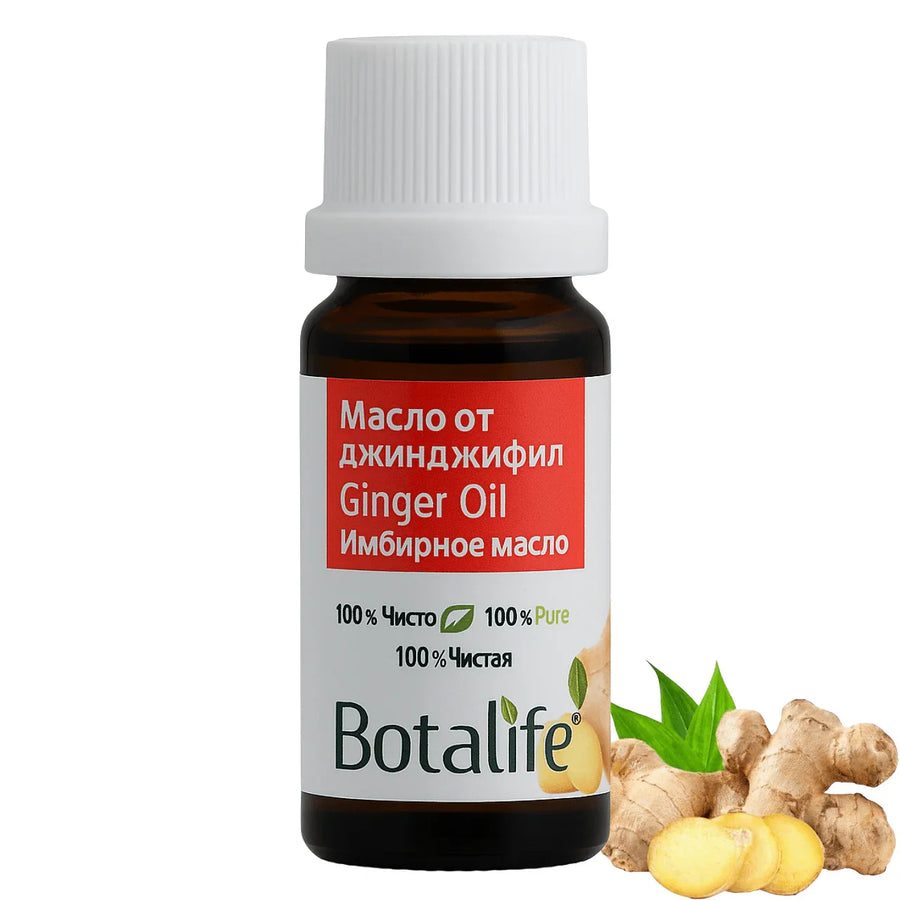
Ginger essential oil, 10 ml
17.90 €
17.90 €
100% pure ginger essential oil
/Zingiber officinalis/
Produced by steam distillation.
Internally: 1–3 drops a day, mixed with 1 tsp of coconut oil or honey and dissolved in 1/2 cup of warm water.
Externally: aromatherapy, massage, gargling.
Ginger oil is extremely strong and must be diluted with a carrier oil at a ratio of 1:5 when used.
Caution! This product is not a medicine! It should not be used as a substitute for a varied and balanced diet! Do not exceed the recommended daily dose! Not to be used by pregnant or breastfeeding women or by young children!
If taken together with medicinal products, consult a pharmacist!
*The effects, methods of use and dosages apply only to products of this brand, for which Botalife guarantees the concentration, purity, quality and origin of the oils.
1. Anti-inflammatory action: Ginger oil has been shown to significantly reduce markers of inflammation. Its pain-relieving and anti-inflammatory properties are used for diseases of the musculoskeletal system – arthritis, rheumatism, osteochondrosis, radiculitis, sciatica, neuralgia, neuritis, sprains, bruises and even strained tendons.
A 2018 study found that ginger oil is strongly anti-inflammatory and prevents changes in markers of kidney function or molecules associated with inflammation.
A 2016 study found that ginger oil significantly inhibits chronic joint swelling.
2. Nausea and vomiting:Ginger oil is used for motion sickness (seasickness, air travel) and digestive upsets (upset stomach, vomiting, diarrhoea).
A 2017 study evaluated the effectiveness of inhaling ginger oil to relieve post-operative nausea after abdominal surgery. The researchers found that participants who inhaled ginger oil rated their levels of nausea and vomiting lower than those in the placebo group.
3. For infections:Ginger oil acts as an antiseptic that kills infections caused by microorganisms and bacteria. This includes intestinal infections, bacterial dysentery and food poisoning. Laboratory studies have shown that it has antifungal properties.
An in vitro study published in the Asian Pacific Journal of Tropical Disease found that the compounds in ginger essential oil are effective against Escherichia coli, Bacillus subtilis and Staphylococcus aureus. Ginger oil is also able to inhibit the growth of Candida albicans.
4. For respiratory problems: Ginger oil has a proven effect in colds and respiratory illnesses, catarrh of the upper airways, sinusitis and tonsillitis. Ginger oil removes mucus from the throat and lungs and is known as a natural remedy for colds, flu, coughs, asthma, bronchitis and also shortness of breath.
Studies show that ginger essential oil serves as a natural remedy for patients with asthma. Asthma is a respiratory disease that causes muscle spasms of the bronchi, swelling of the lung lining and increased mucus production. This makes it impossible to breathe easily. It can be caused by pollution, obesity, infections, allergies, exercise, stress or hormonal imbalance. Because of the anti-inflammatory properties of ginger essential oil, it reduces swelling in the lungs and helps open the airways.
A study by researchers from Columbia University Medical Center and the London School of Medicine and Dentistry found that ginger and its active components cause significant and rapid relaxation of the smooth muscles of the human airways. The researchers concluded that the compounds found in ginger may provide a therapeutic option for patients with asthma and other airway diseases, alone or in combination with other accepted therapies such as beta2-agonists.
5. Strengthens heart health: Ginger oil has the power to reduce cholesterol levels and blood clotting. According to the University of Maryland Medical Center, several preliminary studies show that it can lower cholesterol and prevent blood clotting, which may help treat heart disease in which blood vessels can become blocked and lead to a heart attack or stroke.
As well as lowering cholesterol levels, ginger oil also improves lipid metabolism, helping to reduce the risk of cardiovascular disease and diabetes.
6. Relieves muscle and menstrual pain: Because of its pain-relieving components, ginger oil provides relief from menstrual cramps, headaches, back pain and soreness. Research shows that taking 1–2 drops of ginger oil a day is more effective at treating muscle and joint pain than the painkillers prescribed by GPs – thanks to its ability to reduce inflammation and boost circulation.
7. For nervous and psychological problems: anxiety, memory problems, pessimism, worry, nervous and mental exhaustion and disorientation. When used in aromatherapy, ginger oil can relieve feelings of anxiety, depression and exhaustion.
In Ayurvedic medicine, ginger oil is believed to heal emotional problems such as fear, abandonment and a lack of self-esteem or motivation.
A study published in ISRN Obstetrics and Gynecology found that when women suffering from PMS took two drops of ginger oil a day for seven days before and three days after menstruation, over three cycles, they experienced a reduction in the severity of mood and behavioural symptoms.
According to another study, ginger essential oil activates the human serotonin receptor, which may help relieve anxiety.
Certificate No.: TR-32-К-003617
Packaging: glass bottle with dropper, 10 ml
Storage: in a dark, cool place, out of the reach of children, with the cap tightly closed
Best before: see packaging
Manufacturer: Manolya Dogal ve Aromatik, Turkey
Exclusive importer for Bulgaria: Botalife Bulgaria Ltd.
The 8 best oils for asthma symptoms
Essential oils for travel – how to create your own kit
TOP 5 essential oils for irritable bowel syndrome
Essential oils used for digestive problems
TOP 11 essential oils for herpes
TOP 12 essential oils for diarrhoea and how to use them
Essential oil conversion table, calculator and professional tips
TOP 9 essential oils for a sore throat
The best essential oils for muscle pain, tension, swelling and oedema
Essential oils to avoid during pregnancy and breastfeeding
TOP 8 benefits of using bay leaf oil and how to use it
4 ways to use essential oils safely internally, with recipes
Diffuser blends for the respiratory system
The effects and uses of essential oils on the human body
How to use essential oils at home
TOP 16 essential oils for gout
TOP 4 antibacterial essential oils
Main uses of various Botalife essential oils – Part 1
Our way to prevent and deal with flu, colds and viruses
A powerful antiviral and anti-flu drink
Emotional balance and the nervous system
The vibrations of essential oils and how to use them – Part 2
The vibrations of essential oils – Part 1
How to deal with an unpleasant cough?
Can essential oils help with Crohn's disease?
Recipes for the immune system with Botalife essential oils
Top 13 essential and plant oils for clearing parasites from the body
TOP 10 essential oils for weight loss
Winter magic with essential oils
Can essential and plant oils help in the fight against excess weight?
Ginger is one of the healthiest foods in the world. It is a rich source of manganese, magnesium, potassium, copper, iron, zinc, phosphorus, vitamins B3, B6 and C, amino acids and more.
Ginger gives a distinctive spicy, aromatic flavour to the many dishes it is added to. It appears in half of all Chinese and Ayurvedic recipes. It is an important herb that reduces toxicity and balances the other herbs in recipes.
It originates from China. It stimulates the appetite, is an excellent carminative (improves the release of intestinal gas) and an intestinal antispasmodic (relieves and soothes the digestive tract).
It has a laxative effect and relaxes the muscles of the intestines. It tones and relieves fatigue. The herb is a gift from nature.
The benefits of ginger as a healing food are well known in Asia.
Translated from Sanskrit, ginger means universal medicine. According to Chinese medicine, it acts on the heart, lungs and stomach. The rhizome is used for medicinal purposes.
The biologically active substances in the ginger rhizome are gingerols, shogaols and the essential oils zingiberene, cineole, camphene and phellandrene. These substances stimulate digestion, increase the secretion of digestive juices, neutralise stomach acid and tone the muscles of the digestive tract.
Gingerols soothe nausea and vomiting. Their effect on nausea is recognised worldwide, and they are used for motion sickness (seasickness, air travel) and digestive upsets (upset stomach, vomiting, diarrhoea). Gingerols can inhibit the growth of Helicobacter pylori. Gingerols and shogaols have proven anti-cancer properties. Dr Rebecca Liu of the University of Michigan showed in laboratory experiments that gingerols kill ovarian cancer cells by causing apoptosis (programmed cell death) and autophagy (self-digestion). Dr Chung Chen and colleagues presented conclusive evidence that shogaols cause apoptosis in cancer cells.